How SEC Enforcement Actions Work: 2026 Guide
How SEC Enforcement Actions Work: 2026 Guide

SEC enforcement actions are formal legal procedures initiated by the Securities and Exchange Commission to investigate and penalize violations of federal securities laws. The SEC Division of Enforcement drives this process, from opening an inquiry to pursuing civil or administrative charges. Understanding how SEC enforcement actions work is no longer optional for compliance officers and legal counsel. The 2026 update to the SEC Enforcement Manual introduced procedural reforms that materially shift the balance of rights and obligations at every stage of an investigation.
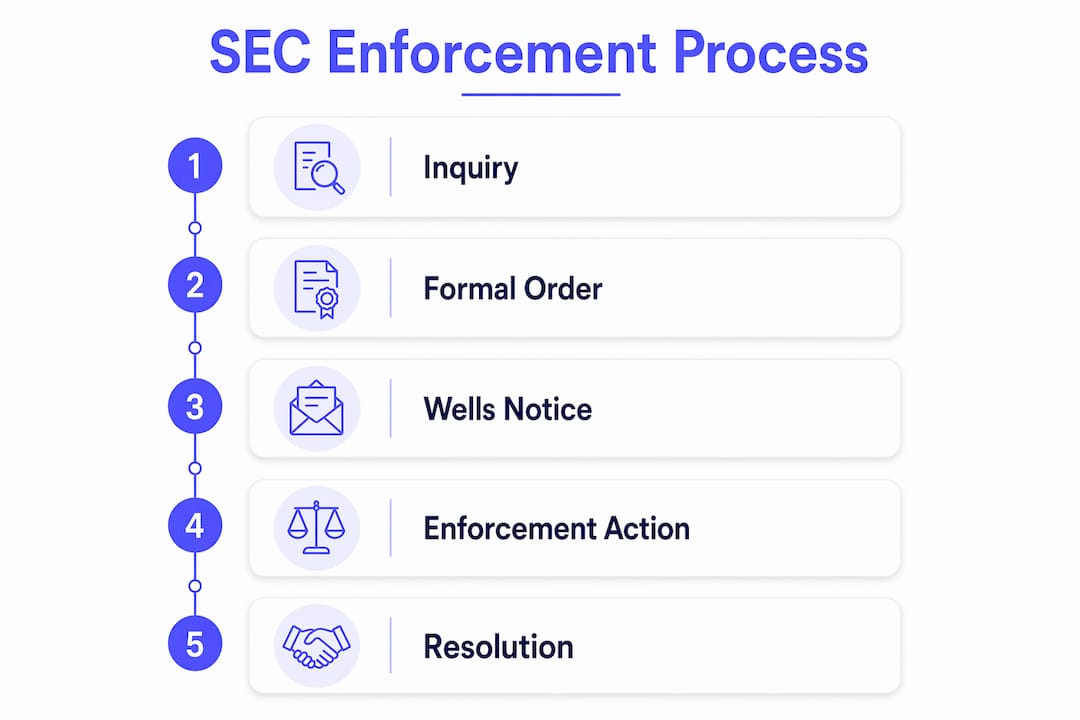
How SEC enforcement actions are initiated and Formal Orders issued
The SEC investigations process begins with a Matter Under Inquiry (MUI), an informal review triggered by tips, referrals, market surveillance, or self-reported disclosures. Staff analysts review publicly available data, SEC filings, and trading records to determine whether a full investigation is warranted. If the evidence supports escalation, the matter converts to a formal investigation.
The Formal Order is the critical threshold. It marks the transition from voluntary cooperation to compulsory investigative authority. Once issued, staff can issue subpoenas, compel testimony under oath, and demand document production from third parties. The Formal Order approval process now requires staff to prepare a detailed memo and proposed order for review by the Division’s Office of the Director and the full Commission before issuance. This is a significant procedural shift from prior delegations that allowed more localized approval.

This change has two direct consequences for subjects of an investigation. First, it signals that the Commission itself has reviewed and authorized compulsory process, raising the institutional weight of the inquiry. Second, it creates a documented record of the evidentiary basis for the investigation, which defense counsel can reference in later proceedings.
Key facts about the Formal Order stage:
-
Subpoena power attaches only after a Formal Order is issued, not during the MUI phase
-
Document preservation obligations intensify immediately upon issuance
-
Third-party subpoenas to banks, brokers, and counterparties become available to staff
-
The subject is typically not notified of the MUI, but may learn of the formal investigation through a subpoena or testimony request
Pro Tip: If your organization receives a document subpoena or testimony request, treat it as confirmation that a Formal Order exists. Initiate a litigation hold immediately and engage outside counsel before producing a single document.
Understanding how SEC actions are initiated at this early stage gives compliance teams the clearest opportunity to shape the trajectory of an investigation through organized, timely cooperation.
What is the Wells notice process and what changed in 2026?
The Wells notice is the formal mechanism by which SEC staff informs a potential respondent that it intends to recommend enforcement action. It is the most consequential due process checkpoint in the entire SEC enforcement procedure, and the 2026 Enforcement Manual reforms substantially expanded the rights of recipients.
The updated process works as follows:
-
Dual approval required. Staff must obtain sign-off from both the supervising Associate Director or Unit Chief and the Office of the Director before issuing a Wells notice. This prevents unilateral staff decisions and adds a layer of institutional review.
-
Evidence disclosure expanded. Staff must now disclose salient, probative evidence to the recipient, including evidence the recipient may not already know exists, subject to applicable confidentiality constraints. This is a meaningful departure from the prior practice of withholding the investigative record.
-
Submission period doubled. Recipients receive a standard four-week window to prepare and submit a Wells submission, up from the previous two-week standard. Extensions are available and the Manual encourages granting them when warranted.
-
Post-Wells meetings formalized. Meetings must be scheduled within four weeks of the submission and must include senior leadership at the Associate Director level or above. Recipients are limited to one such meeting.
-
Mandatory rejection scenarios. The Manual specifies circumstances under which Wells submissions must be rejected, providing clearer procedural boundaries for both staff and respondents.
The Wells process reforms are widely viewed as an extension of due process, designed to prevent a one-sided prosecutorial dynamic and give respondents a genuine opportunity to influence staff recommendations before charges are filed.
Pro Tip: Use the full four-week submission period strategically. A rushed Wells submission that fails to address the specific evidence disclosed by staff is worse than a well-organized, extension-supported response that directly rebuts the key factual and legal theories.
The post-Wells meeting with Associate Director-level staff is not a formality. It is your single structured opportunity to present your client’s position directly to decision-makers before the recommendation is finalized.
What types of SEC enforcement actions and outcomes should you expect?
The SEC pursues two primary categories of formal action: civil injunctive actions filed in federal district court, and administrative proceedings conducted before an SEC administrative law judge. The choice between these tracks depends on the nature of the alleged violation, the relief sought, and strategic considerations within the Division of Enforcement.
Civil injunctive actions are used when the SEC seeks injunctions, civil monetary penalties, or disgorgement of ill-gotten gains through the federal court system. Administrative proceedings are used for matters involving registered entities, broker-dealers, investment advisers, and accountants, where the SEC seeks bars, suspensions, or censures in addition to monetary relief.
| Enforcement type | Typical relief sought |
|---|---|
| Civil injunctive action | Injunction, disgorgement, civil penalties |
| Administrative proceeding | Bars, suspensions, censures, monetary penalties |
| Deferred prosecution agreement | Cooperation credit, monitorship, no formal charges |
| Settled order | Cease-and-desist, disgorgement, officer/director bar |
In SEC fiscal year 2025, 456 enforcement actions were filed, resulting in $17.9 billion in monetary relief. Two-thirds of those actions involved individual defendants, and 119 individuals were barred from serving as officers or directors. That scale reflects a Division that targets individual wrongdoers as a deliberate strategy to protect investors and market integrity, not just corporate entities.
One of the most significant recent changes to SEC enforcement procedures is the rescission of the “no-deny” policy in May 2026. Previously, respondents settling with the SEC were required to waive their right to publicly deny the allegations. That requirement is now gone. Respondents can settle and simultaneously issue public statements contesting the factual narrative. This shifts the calculus in settlement negotiations, particularly for executives whose reputations are at stake.
Practical implications for compliance and legal teams
The updated SEC enforcement framework creates both new risks and new leverage points for internal teams. The following priorities apply from the moment a matter is opened through the post-Wells phase.
-
Begin internal investigations immediately. Once a subpoena or informal request arrives, start collecting and preserving records before staff issues a Formal Order. Waiting until compulsory process is in place limits your ability to organize the record on your own terms.
-
Map the evidentiary record early. The Enforcement Manual holds staff responsible for disclosing evidence to Wells recipients. Knowing your own documents before staff does allows you to anticipate what will be disclosed and prepare targeted responses.
-
Treat the Wells submission as a legal brief, not a letter. The expanded four-week period and evidence disclosure requirements mean you now have the material to construct a substantive factual and legal defense. Generic submissions that express cooperation without addressing the specific evidence are a missed opportunity.
-
Coordinate post-Wells meeting logistics in advance. The one-meeting limit is strict. Prepare a structured presentation that addresses the staff’s core theories, not just your preferred narrative.
-
Understand the waiver implications of settlement. With the no-deny policy rescinded, settlement no longer requires silence. Coordinate with communications counsel to prepare public statements that align with the legal resolution without creating new exposure.
Pro Tip: Review your organization’s SEC filing disclosures during the investigation period. Enforcement staff routinely cross-reference public filings with internal records. Inconsistencies between MD&A disclosures and internal communications are a common source of additional charges.
Compliance officers should also monitor SEC filing red flags proactively, since accounting irregularities and risk factor changes in 10-Ks and 10-Qs frequently precede or accompany enforcement referrals.
Key takeaways
SEC enforcement actions follow a structured, multi-stage process governed by the 2026 Enforcement Manual, and the Wells notice stage now offers the most procedurally protected opportunity for respondents to influence outcomes before charges are filed.
| Point | Details |
|---|---|
| Formal Order triggers compulsory authority | Subpoena power and preservation obligations attach the moment a Formal Order is issued. |
| Wells notice reforms doubled response time | Recipients now have four weeks to submit, with evidence disclosed by staff in advance. |
| FY 2025 enforcement scale | 456 actions filed, $17.9 billion in relief, 119 officer/director bars imposed. |
| No-deny policy rescinded | Respondents can now settle and publicly contest the factual allegations simultaneously. |
| Post-Wells meeting is a one-time opportunity | One meeting is permitted with Associate Director-level staff; preparation is non-negotiable. |
The 2026 reforms shift more power to respondents than most practitioners realize
The procedural changes in the 2026 Enforcement Manual are not cosmetic. The combination of mandatory evidence disclosure, doubled submission timelines, dual approval for Wells notices, and the rescission of the no-deny policy represents a genuine recalibration of the enforcement process toward procedural fairness.
What I find most significant is the evidence disclosure requirement. For years, Wells submissions were written partially blind. Counsel knew the general theory of the case but rarely had access to the specific documents staff considered most probative. The new requirement changes that dynamic. You now receive the staff’s best evidence before you respond. That is a structural advantage that skilled defense counsel will use to construct targeted, document-specific rebuttals rather than broad legal arguments.
The no-deny rescission is equally underappreciated. The prior policy created a perverse incentive: settle and stay silent, or litigate and speak freely. That forced silence often damaged reputations more than the underlying conduct. Removing that constraint gives executives and firms a legitimate path to resolution that does not require accepting a one-sided public narrative.
The challenge for compliance teams is that these reforms also raise expectations. Staff now operates under tighter controls, more documentation requirements, and greater institutional oversight. That means investigations will be more thoroughly documented and harder to challenge on procedural grounds. The window for influencing outcomes has shifted earlier in the process, toward the internal investigation phase and the Wells submission, not toward post-charge litigation.
If you are a compliance officer or legal counsel, the practical takeaway is this: invest more resources at the front end of an investigation. The reforms reward preparation, not reaction.
— Matthew
How Filingsiq supports your SEC compliance workflow

Staying ahead of SEC enforcement trends requires more than legal knowledge. It requires continuous monitoring of public filings for the same red flags that enforcement staff tracks. Filingsiq provides an AI-powered platform that analyzes 10-Ks, 10-Qs, and other SEC filings in minutes, surfacing accounting irregularities, risk factor changes, and MD&A inconsistencies that frequently precede enforcement referrals. For compliance officers managing multiple entities or analysts tracking counterparty risk, the platform reduces manual review time and surfaces material disclosures before they become enforcement issues. Explore how Filingsiq works to support your team’s regulatory monitoring and filing analysis workflows. You can also visit FilingsIQ.ai to start analyzing filings directly.
FAQ
What triggers an SEC enforcement action?
An SEC enforcement action is typically triggered by tips, market surveillance, referrals from self-regulatory organizations, or anomalies identified in SEC filings. Staff opens a Matter Under Inquiry and escalates to a formal investigation if the initial review supports it.
How long does the SEC investigations process take?
The timeline varies significantly by case complexity, but formal investigations routinely span one to three years from Formal Order issuance to a charging recommendation. The Wells notice and submission period add several additional weeks to the process.
What is a Wells notice and who receives one?
A Wells notice is a formal communication from SEC staff informing a potential respondent that staff intends to recommend enforcement action. Recipients include individuals and entities against whom charges are being considered, and they have the right to submit a written response before staff finalizes its recommendation.
Can you settle an SEC action without admitting wrongdoing?
Yes. The SEC’s standard settlement language includes a neither-admit-nor-deny provision. With the rescission of the no-deny policy in May 2026, respondents can now also publicly contest the factual allegations while still settling the matter.
What penalties can result from SEC enforcement actions?
Penalties include civil monetary fines, disgorgement of profits, injunctions, and officer or director bars. In fiscal year 2025, SEC enforcement actions produced $17.9 billion in total monetary relief, with 119 individuals barred from serving in executive roles.
Recommended
Related insights
Ready to analyze filings faster?
Try FilingsIQ free and turn SEC filings into actionable research in minutes.