How to Find Company Risks in SEC Filings
How to Find Company Risks in SEC Filings
SEC filings run hundreds of pages, and the risks that matter most are rarely on page one. For analysts and investment managers trying to find company risks in SEC filings, the challenge is not access, it is knowing exactly where to look, what to read critically, and how to separate a genuine warning from boilerplate legal cover. This guide walks you through the specific sections, techniques, and evaluation frameworks that turn dense regulatory documents into decision-ready intelligence.
Table of Contents
-
How to critically assess the significance of disclosed risks
-
How Filingsiq makes SEC risk analysis faster and more accurate
Key takeaways
| Point | Details |
|---|---|
| Start with Item 1A | The Risk Factors section in 10-K and 10-Q filings is the mandatory starting point for any SEC filings risk assessment. |
| Assess probability and impact | Evaluate the language used around likelihood and magnitude to distinguish material risks from generic disclosures. |
| Track changes across filings | Comparing risk disclosures across quarters and annual reports reveals emerging vulnerabilities before they become crises. |
| Watch Form 8-K for real-time signals | Material cybersecurity incidents and other sudden events must be disclosed on Form 8-K, making it a critical monitoring tool. |
| Use technology to scale your review | AI-powered platforms can extract and flag risk factor changes across filings in a fraction of the manual time. |
What you need before analyzing SEC risk disclosures
Before you can efficiently find company risks in SEC filings, you need a clear map of which documents to prioritize and what each one contains.
The three filings that matter most
-
10-K (Annual Report): The most complete risk disclosure document. Item 1A contains the full Risk Factors section, which must be tailored to company-specific circumstances, not just generic industry warnings.
-
10-Q (Quarterly Report): Updates material changes to risk factors since the last annual filing. If a company adds a new risk mid-year, the 10-Q is where it first appears. Learn more about how 10-Qs drive decisions for ongoing monitoring.
-
Form 8-K (Current Report): Triggered by material events. In 2026, companies must disclose cybersecurity incidents within four business days of determining materiality, making 8-K monitoring non-negotiable for operational risk assessment.
Tools and foundational knowledge you need
| Tool / Knowledge Area | Purpose |
|---|---|
| SEC EDGAR (full-text search) | Access filings by company, form type, date range, and keyword |
| EDGAR Advanced Search | Filter for specific risk-related terms across thousands of filings |
| MD&A section literacy | Cross-reference management commentary with disclosed risk factors |
| Financial statement basics | Validate whether quantified risks appear in footnotes or reserves |
| Legal probability language | Decode terms like “may,” “could,” and “likely” in risk disclosures |

You also need basic legal and financial literacy to decode the language companies use. Risk disclosures are written by lawyers, which means precision matters. The MD&A section is particularly useful for cross-referencing what management says about risks versus what the numbers actually show.
Pro Tip: Before reading any Risk Factors section, skim the MD&A and financial footnotes first. This gives you context for which disclosed risks the company is already provisioning for financially.
How to locate and extract risk factors systematically
Knowing a risk section exists is one thing. Pulling the right information out of it efficiently is another. Here is a repeatable process for any filing.
-
Go directly to EDGAR Full-Text Search. Use EDGAR’s advanced search to filter by company name, CIK number, form type (10-K or 10-Q), and date range. This eliminates irrelevant documents immediately.
-
Navigate to Item 1A. In most 10-K filings, the table of contents is hyperlinked. Click directly to Item 1A rather than scrolling. In older or non-hyperlinked filings, use Ctrl+F and search “Item 1A” to jump to the section.
-
Read the headings before the text. Companies organize risk factors under subheadings such as “Risks Related to Our Business,” “Regulatory Risks,” and “Financial Risks.” Scan these headings first to identify which categories are present and which are absent. A missing category can be as informative as a present one.
-
Flag language that signals severity. Words like “material adverse effect,” “significant uncertainty,” and “cannot guarantee” indicate higher-severity disclosures. Softer language like “may” or “could” signals lower probability but should still be tracked.
-
Run keyword searches within the document. Search for terms like “litigation,” “going concern,” “concentration,” “covenant,” “regulatory investigation,” and “material weakness.” These terms frequently cluster around the highest-impact risks in any filing.
-
Compare the current filing to the prior period. Download both filings and use a document comparison tool or a side-by-side review. Comparing risk disclosures across multiple filings reveals trends, new risks, or escalation that a single-period review will miss entirely.
Pro Tip: Create a standardized extraction template with columns for risk category, probability language, potential impact, and mitigation strategy. Filling this in consistently across filings makes peer comparison and trend analysis far faster.
How to critically assess the significance of disclosed risks
Finding risks in a filing is only half the work. The harder task is determining which ones actually matter for your investment thesis. This is where SEC filings risk assessment becomes a genuine analytical skill.
Evaluating probability and magnitude
The SEC requires companies to assess risks by likelihood, impact, and mitigation. As an analyst, you apply the same framework in reverse. When a company says a regulatory change “could” affect revenue, that is different from saying it “is likely to materially reduce” revenue. Pay close attention to verb tense and modal language. Escalation in the strength of probability language from one filing to the next is a meaningful signal.
Quantified risk statements carry more weight than qualitative ones. If a company discloses that a single customer represents 40% of revenue and that customer is renegotiating its contract, the concentration risk is specific and measurable. Generic statements about competitive pressure are far less useful for portfolio decisions.
Identifying boilerplate versus tailored disclosures
SEC Chair Atkins has specifically warned against “kitchen sink” risk disclosures, where companies list every conceivable risk regardless of relevance. Your job is to separate the filler from the substance. Boilerplate risks tend to be industry-wide, non-specific, and unchanged across multiple filings. Tailored risks reference specific contracts, geographies, technologies, or regulatory proceedings.
Watch for these red flags during your review:
-
Risk factors that are identical word-for-word to the prior year filing, even when the company’s circumstances have changed
-
Vague statements about “macroeconomic conditions” with no company-specific linkage
-
Absence of cybersecurity risk disclosures in technology-dependent businesses, particularly given 2026 requirements around AI and deepfake-related risks
-
Mitigation strategies described in passive or aspirational terms (“we intend to,” “we plan to”) rather than concrete operational controls
“Well-drafted risk factors provide a strong defense against securities fraud allegations, which incentivizes companies to disclose thoroughly yet authentically.” — White & Case LLP
This cuts both ways. Companies with strong legal counsel tend to produce more specific, credible disclosures. When you see a filing with unusually vague risk language, that itself is a data point worth investigating.
Cross-checking consistency
Risk disclosures should be consistent with the MD&A and financial statements. If a company discloses significant litigation risk in Item 1A but shows no legal reserves in the balance sheet footnotes, that inconsistency deserves follow-up. Similarly, if management discusses a new market expansion in the MD&A but the Risk Factors section contains no new geographic or regulatory risks, something is missing. For a deeper look at spotting these inconsistencies, the guide on red flags in SEC filings covers this in practical detail.
Verifying disclosures and monitoring risks over time
A single filing review is a snapshot. Real risk assessment requires a continuous process, and the structure of SEC reporting supports exactly that if you build the right workflow.
Comparing filings across periods
| Comparison Type | What to Look For | Why It Matters |
|---|---|---|
| Year-over-year 10-K | New risk categories added or removed | Signals strategic shifts or emerging threats |
| Quarter-over-quarter 10-Q | Escalation in probability language | Early warning of deteriorating conditions |
| 8-K vs. 10-K risk factors | Material events disclosed between annual filings | Identifies gaps in annual risk narrative |
| Peer company 10-Ks | Risks disclosed by competitors but absent from target | Flags potential blind spots or selective disclosure |
Form 8-K filings deserve particular attention in 2026. The SEC’s cybersecurity disclosure rules require companies to report material incidents promptly, making Form 8-K monitoring a real-time complement to your periodic filing reviews.
Building a sustainable monitoring process
Errors in SEC filings lead to comment letters, restatements, and loss of investor trust. The same principle applies to your analysis process. Poor version control and manual errors in tracking risk factor changes create gaps in your risk picture. Maintain a filing log for each ticker you cover, noting the date reviewed, key risks identified, and any changes from the prior period.
Benchmarking against industry peers is equally important. If every competitor in a sector discloses supply chain concentration risk and your target company does not, that absence is a question worth asking on the next earnings call.
Pro Tip: Set up EDGAR email alerts for your covered companies. You will receive notification the moment a new 10-K, 10-Q, or 8-K is filed, keeping your risk monitoring current without manual checking.
My perspective on mastering SEC risk disclosures
I have reviewed hundreds of 10-K filings across sectors, and the analysts who consistently outperform are not the ones who read the most filings. They are the ones who read them most critically.
The biggest mistake I see, even among experienced professionals, is treating the Risk Factors section as a legal formality rather than an analytical resource. In my experience, the most valuable information is often in what changed, not what is present. A company that quietly removes a previously disclosed litigation risk without any corresponding resolution in the financials is telling you something. You just have to be looking for it.
The 2026 SEC requirements around cybersecurity and AI-related disclosures have added real complexity. I find that many analysts are still calibrating how to weight these newer risk categories against traditional financial and operational risks. My view is that cyber and AI risks deserve the same quantitative scrutiny as credit or market risks. If a company cannot articulate its exposure in specific terms, that vagueness is itself a risk signal.
SEC filing compliance is best treated as an ongoing process rather than a periodic event, and the same logic applies to your analysis workflow. The analysts I respect most have built systems, not just skills. They track changes, flag anomalies, and integrate filing data into their broader investment process continuously. That discipline is what separates a thorough risk review from a genuinely useful one.
— Matthew
How Filingsiq makes SEC risk analysis faster and more accurate

Manually tracking risk factor changes across dozens of 10-K and 10-Q filings is time-consuming and prone to the exact version control errors that create blind spots in your analysis. Filingsiq addresses this directly with an AI-powered platform built specifically for financial analysts and investment managers who need to analyze company risk factors at scale.
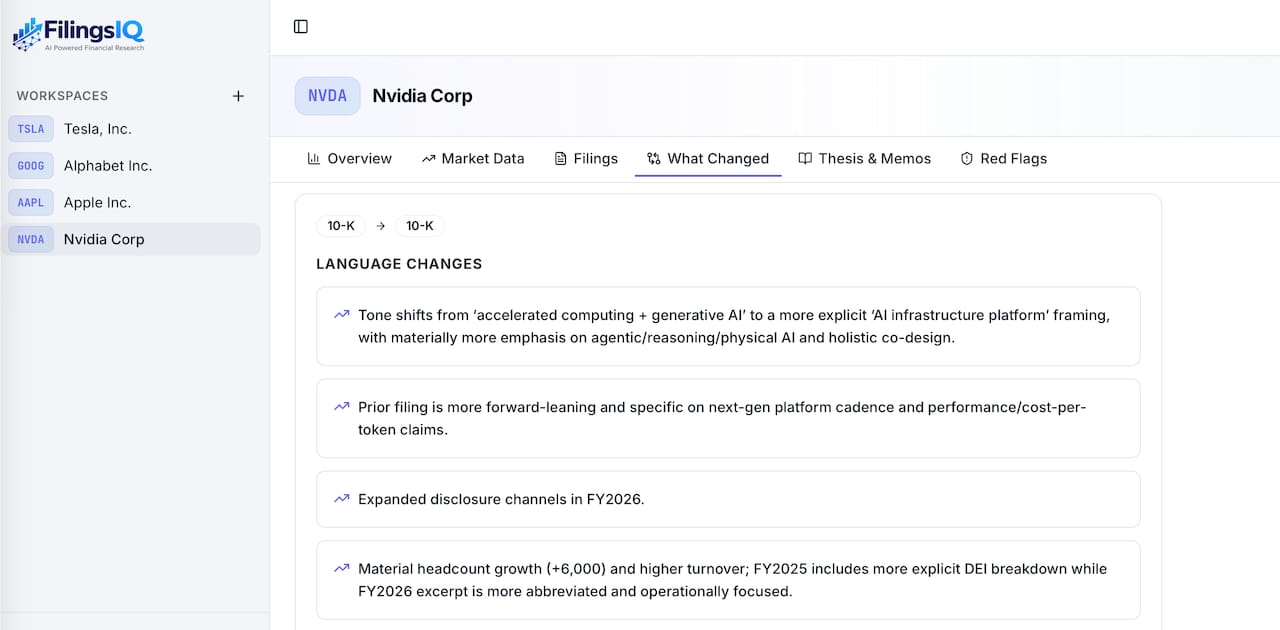
Filingsiq integrates with EDGAR to pull filings automatically, then extracts and summarizes key risk disclosures, financial highlights, and MD&A commentary in minutes. The platform flags changes in risk factor language between filings, so you can see at a glance what a company added, removed, or modified without reading every word of a 150-page document. For teams covering large universes of tickers, this capability alone cuts research time significantly.
The platform also organizes each ticker into a dedicated workspace, giving you a structured view of historical filings, risk summaries, and flagged anomalies in one place. Want to understand how the AI works under the hood? The how it works page walks through the extraction and summarization process in detail. If you are ready to evaluate it for your workflow, pricing details are available for teams of all sizes.
FAQ
What section of a 10-K contains company risk factors?
Risk factors are disclosed in Item 1A of the 10-K annual report and are also updated in 10-Q quarterly filings when material changes occur.
How do I assess whether a disclosed risk is material?
Evaluate the probability language used (such as “likely” versus “may”), the potential financial impact described, and whether the company provides specific mitigation controls rather than general statements.
What is the difference between boilerplate and tailored risk disclosures?
Boilerplate disclosures are generic, unchanged across filings, and non-specific to the company’s actual circumstances. Tailored disclosures reference specific contracts, geographies, regulatory proceedings, or financial exposures relevant to that company.
How often should I review a company’s SEC risk disclosures?
Review the 10-K annually and each 10-Q as it is filed. Monitor Form 8-K filings continuously, as material events including cybersecurity incidents must be disclosed within four business days of a materiality determination.
Can I use EDGAR to compare risk factors across filings?
Yes. EDGAR’s full-text search allows you to filter by company, form type, and date range. Downloading consecutive filings and running a document comparison gives you a clear view of what changed between periods.
Recommended
-
How To Spot Red Flags In SEC Filings: A Practical Guide For RIAs And Analysts | FilingsIQ.ai
-
Filing Insights – SEC Filing Guides & Glossary | FilingsIQ.ai
-
5 SEC Filing Red Flags Every RIA Should Watch For | FilingsIQ.ai
-
How to Analyze a 10-K Filing: A Practical Guide for RIAs and Investment Analysts | FilingsIQ.ai
Related insights
Ready to analyze filings faster?
Try FilingsIQ free and turn SEC filings into actionable research in minutes.