The Role of Natural Language Processing in SEC Filings
The Role of Natural Language Processing in SEC Filings

The role of natural language processing in filings analysis has fundamentally changed what it means to review an SEC document. Before NLP became viable for financial text, a single 10-K could run 200 pages, and analysts spent hours just locating the sections that mattered. That bottleneck was expensive, inconsistent, and unscalable for firms monitoring hundreds of tickers simultaneously. Today, NLP reduces manual reading bottlenecks across entire research workflows, giving financial professionals something they have always wanted: speed without sacrificing depth.
Table of Contents
Key Takeaways
| Point | Details |
|---|---|
| NLP automates filing triage | Structured summaries are produced within minutes of an EDGAR drop, directing analyst attention to what matters most. |
| FinBERT and BART power finance-specific NLP | Industry-adapted models handle sentiment classification and summarization far more accurately than general-purpose tools. |
| Risk scoring goes paragraph-level | Severity and novelty metrics on Item 1A disclosures let you compare risk language year-over-year with quantifiable precision. |
| Evidence-first outputs build audit trust | Citation enforcement in regulatory NLP systems prevents hallucinations and supports compliant decision records. |
| Human review stays non-negotiable | Fully automated outputs require governance controls, especially for high-severity compliance findings. |
How NLP technology reshapes filing analysis
Natural language processing, more formally known as computational linguistics applied to financial text, refers to a set of machine learning techniques that parse, interpret, and extract structured information from unstructured documents. In SEC filing contexts, “NLP technology in filings” is not a single tool. It is a pipeline of specialized components working in sequence.
The core tasks in any production-grade financial NLP system include:
-
Sentiment analysis: Models like FinBERT, which is pre-trained on financial corpora, classify tone within MD&A sections and risk disclosures with higher accuracy than general models trained on news or social media.
-
Named entity recognition (NER): Extracts company names, dollar amounts, dates, and regulatory references from dense legal text.
-
Summarization: BART-based models condense lengthy filings into structured summaries, typically organized by section such as financials, risk factors, and management commentary.
-
Semantic search: Embedding-based retrieval lets analysts query across hundreds of filings with natural language questions rather than keyword searches.
-
XBRL concept mapping: Open-source pipelines now include industry-aware XBRL extraction covering approximately 250 concept mappings, linking tagged financial data to NLP outputs for cross-validation.
Production pipelines also embed validation checks that catch data errors before they reach the analyst. A common example is a sanity rule: revenue must be greater than or equal to net income. These checks sound simple, but they prevent downstream errors that would otherwise corrupt risk models.
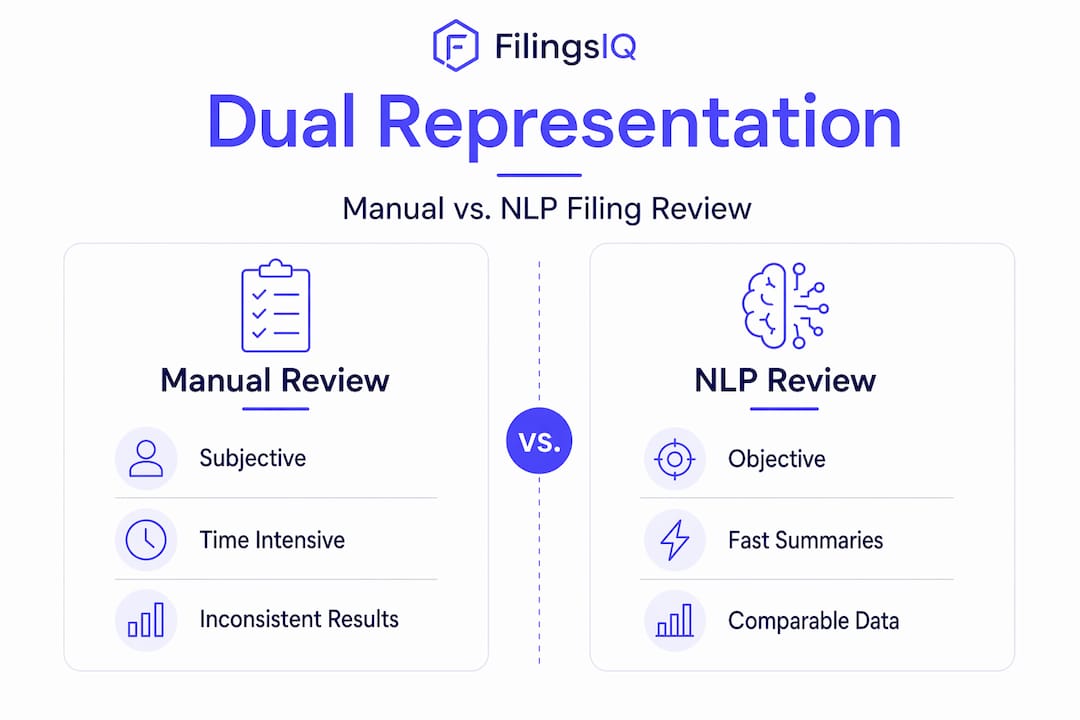
Pro Tip: When evaluating any NLP tool for SEC filings, ask specifically whether it uses dual representation, which means embedding-based semantic retrieval combined with schema-constraint validation. Dual representation designs improve both robustness and auditability of outputs.
How NLP transforms the analyst workflow
The pre-NLP workflow followed a predictable pattern. An analyst received an alert about a new filing, downloaded the document from EDGAR, and began reading from the top. If you were lucky, you had a checklist. If not, the review was as thorough as time allowed.
Here is how that workflow changes with a mature NLP pipeline in place:
-
Ingestion at the EDGAR drop. The moment a filing becomes public, automated systems retrieve it and begin parsing. Large asset managers process filings via NLP within minutes of publication, producing structured summaries before most analysts have opened their email.
-
Structured summary production. The pipeline segments the document by section, extracts key financial metrics, flags risk factor changes, and generates plain-language summaries of each major component.
-
Exception routing. Rather than reading every filing, NLP restructures analyst workflow so human attention goes only to filings where material changes, new disclosures, or anomalies were detected.
-
Prioritized queue delivery. Analysts receive a ranked list of filings requiring review, with the highest-priority items surfaced first based on risk scores and disclosure novelty.
-
Supporting evidence attached. Each flagged item links directly to the relevant paragraph in the source document, so the analyst can verify the machine’s output without hunting through the full text.
The efficiency gains here are not marginal. For a portfolio manager covering 150 names, the difference between reading 150 filings manually and reviewing 15 exception reports is the difference between a two-week process and a same-day review. You can explore how analysts are applying this approach in AI-driven equity research to understand what a mature NLP-assisted workflow actually looks like in practice.
Advanced applications: risk scoring and compliance
Beyond extraction and summarization, the more specialized applications of NLP in filing analysis are where the real analytical edge lives.
Semantic risk scoring
Traditional risk analysis compared this year’s Item 1A section to last year’s by reading both. Semantic risk scoring replaces that comparison with quantified metrics. Risk disclosure changes are scored at the paragraph level, with two distinct outputs: a severity score from 0 to 1 reflecting the potential financial impact, and a novelty score from 0 to 1 reflecting how much the language has changed from the prior year’s disclosure.

This creates something analysts have never had before: a backtestable, comparable dataset of risk language across an entire peer group. You can ask which companies in a sector materially increased their cybersecurity risk language in Q3, and get a ranked answer with source citations attached.
| Capability | Manual review | NLP-assisted review |
|---|---|---|
| Risk change detection | Subjective, reading-dependent | Scored 0-1, paragraph-level |
| Year-over-year comparison | Time-intensive, inconsistent | Automated, auditable |
| Peer benchmarking | Rarely feasible at scale | Systematic across full coverage universe |
| Source citation | Analyst notes | Automated with document reference |
Evidence-first compliance monitoring
Regulatory question answering is a different problem. When a compliance officer asks whether a filing satisfies a specific SEC disclosure requirement, the answer cannot be a hallucinated summary. It has to be grounded in the actual document.
Evidence-first regulatory systems address this by applying citation enforcement at the output layer. The system retrieves specific sequences from filings and regulatory texts, attaches them to every answer, and is programmed to refuse to respond when supporting evidence is not found. This refusal mechanism is not a bug. It is what makes the output trustworthy for compliance use.
Compliance NLP systems extend this further, automating monitoring across multiple frameworks including SEC rules, MiFID II, and Basel III. These systems optimize for recall, not precision, because missing a compliance obligation carries far greater risk than generating a false positive that a human reviewer can clear.
Pro Tip: When you use NLP-generated compliance outputs, treat high-severity findings as triggers for human review, not conclusions. Compliance systems require human review for high-severity items precisely because model confidence scores are not equivalent to legal certainty.
You can find a practical overview of how these risk categories map to actual SEC disclosures in the compliance risk categories guide that Filingsiq maintains.
Benefits and real limitations of NLP in filings
The benefits of NLP for legal document processing and SEC filing review are well documented at this point. The limitations are discussed less often, which is where the real risk for practitioners lies.
On the benefit side, the advantages are concrete:
-
Scale without proportional cost. You can monitor 500 filings with the same analyst headcount required to monitor 50 manually.
-
Consistency. NLP applies the same criteria to every document, eliminating the variance between analysts who focus on different sections or bring different interpretive biases.
-
Auditability. Structured outputs with source citations create a reviewable record of how conclusions were reached, which matters for compliance and internal governance.
-
Speed. The impact of NLP on document analysis is most visible in time-to-insight, where multi-hour manual processes compress to minutes.
The challenges deserve equal attention:
-
Adversarial drafting. NLP-parsed filings risk blind spots when companies draft disclosures specifically to evade AI detection patterns, burying material information in language that models do not flag as anomalous.
-
Model brittleness. Sentiment and classification models trained on historical filings may perform poorly on new disclosure formats, regulatory language shifts, or industry-specific terminology they have not seen before.
-
Data quality dependencies. Garbage in, garbage out applies here. XBRL tagging errors and inconsistent section headers across filings can degrade extraction accuracy.
The most mature NLP deployments treat automation as a triage mechanism, not a verdict. Analysts who understand both the power and the boundaries of these tools make better decisions than those who treat model outputs as ground truth.
You can see a practical example of where NLP-flagged findings align with genuine risks in this guide on SEC filing red flags.
My take on where NLP is actually headed
I’ve worked closely enough with financial data pipelines to say this plainly: the firms getting the most value from NLP in SEC filings are not the ones with the most sophisticated models. They are the ones with the clearest opinions about what structured, comparable output looks like.
The major business value from NLP in filings comes from consistent, auditable data points you can compare across years and across peers. Not broad sentiment scores. Not a binary “positive or negative” classification of a 10-K. The firms extracting real alpha from this technology are extracting paragraph-level risk metrics that can be backtested, plotted, and explained to a portfolio committee.
What I’ve seen go wrong, repeatedly, is overconfidence in model outputs without governance structure underneath them. An NLP system that tells you a filing’s risk language increased by 40% year-over-year is only useful if someone has validated what that metric actually predicts. NLP pipeline value is tied directly to whether outputs are structured and validated enough to be reproducible.
The next five years will push NLP further into real-time monitoring, multimodal analysis combining earnings call transcripts with filing text, and more granular peer comparison tools. But the analysts who adopt early and govern carefully will be the ones with defensible processes when those outputs get scrutinized.
— Matthew
How Filingsiq puts NLP to work for you
If you are an analyst or portfolio manager who has read this far, you already understand the gap between manual filing review and what NLP-assisted workflows can produce.

Filingsiq is built specifically to close that gap. The platform automates extraction, summarization, and risk scoring across 10-K and 10-Q filings, delivering structured summaries of financials, MD&A commentary, and risk factor changes in minutes rather than hours. Red flags including accounting irregularities, going-concern language, and material shifts in risk disclosures are surfaced automatically, with direct links to the relevant document sections. Each ticker gets a dedicated workspace, so your research stays organized and your workflow stays focused. Explore what AI-powered filing analysis looks like in practice and see how Filingsiq fits into your existing research process.
FAQ
What is the role of NLP in SEC filing analysis?
NLP automates extraction, summarization, and risk scoring from SEC filings, allowing analysts to process documents within minutes of publication rather than spending hours reading manually.
How does NLP improve risk detection in 10-K filings?
NLP models score risk disclosures at the paragraph level for severity and novelty, enabling year-over-year comparisons and peer benchmarking that manual review cannot replicate at scale.
What NLP models are used for financial filings?
FinBERT handles sentiment classification in financial text, while BART-based models produce section-level summaries. Production pipelines also incorporate XBRL concept mapping for structured data extraction.
Can NLP fully replace human analysts in filing review?
No. NLP functions as a triage and prioritization tool. High-severity compliance findings and material disclosure changes still require human review to ensure accuracy and legal defensibility.
What are the biggest risks of using NLP for SEC filings?
The primary risks are adversarial drafting by companies seeking to evade AI detection, model brittleness on unfamiliar disclosure formats, and governance gaps when analysts treat automated outputs as final conclusions rather than inputs to further review.
Recommended
Related insights
Ready to analyze filings faster?
Try FilingsIQ free and turn SEC filings into actionable research in minutes.