Why Accounting Red Flags Matter to Every Investor
Why Accounting Red Flags Matter to Every Investor

Why recognizing accounting red flags is critical for investors
Accounting red flags are warning signals embedded in a company’s financial statements that point to possible earnings manipulation, liquidity stress, or governance risk. They do not prove fraud on their own, but they tell you where the reported story needs more scrutiny before you commit capital. For investors, missing these signals has historically preceded some of the most severe wealth destruction events in market history.
The core reason these warning signs matter is straightforward: headline earnings are easy to manage. Cash flow, receivables trends, and footnote disclosures are harder to fake consistently across multiple periods. When those relationships break down, the gap between reported performance and economic reality tends to widen until it cannot be hidden.
Key accounting red flags investors should watch include:
-
Discrepancies between net income and cash flow from operations over multiple years
-
Receivables growing faster than revenue, suggesting premature revenue recognition
-
Aggressive expense capitalization that inflates current-period earnings
-
Sudden changes in accounting policies that improve short-term results
-
Governance signals such as CEO duality or weak audit committee independence
Each of these conditions is a diagnostic prompt, not a verdict. The stronger your concern becomes when several of them appear together across the income statement, balance sheet, and cash flow statement simultaneously.
Common accounting red flags investors should watch for
Financial statements are interconnected. A mismatch in one area almost always leaves a trace somewhere else, which is why experienced analysts read all three statements together rather than focusing on earnings alone.
Revenue and receivables anomalies
-
Receivables increasing much faster than revenue, with days sales outstanding rising sharply, signals slowing collections or premature revenue booking.
-
Revenue growth that is disconnected from customer demand or market conditions deserves immediate follow-up in the MD&A.
-
Subscriber or unit growth without proportional revenue growth suggests the reported metrics may be less meaningful than management presents.
Cash flow and earnings quality
-
A CFO/net income ratio consistently below 0.5, or negative while net income is positive, is a classic signal of aggressive accrual accounting.
-
Persistent divergence between operating cash flow and net income across multiple years indicates earnings quality issues that a single-year explanation cannot cover.
-
Large non-cash adjustments on the cash flow statement, such as stock-based compensation or deferred taxes, can inflate reported earnings without generating real cash.
Balance sheet and expense concerns
-
Rising inventory without matching sales growth often reveals weakening demand or operational inefficiencies that management has not yet disclosed.
-
Expense capitalization that defers current costs into future periods inflates near-term margins and distorts comparability across periods.
-
Hiding variable costs within operating expenses makes it harder to assess true unit economics and margin durability.
Governance and disclosure signals
-
Frequent auditor changes and delayed filings beyond normal extension periods are linked to elevated financial statement risk.
-
Executive departures clustered around restatements or regulatory inquiries signal governance concerns worth investigating.
-
Related-party transactions and significant off-balance-sheet obligations can obscure liabilities and real risk exposures from investors who read only the headline numbers.
Additional warning signs
-
Declining profit margins without a clear explanation tied to pricing, input costs, or mix shift.
-
Excessive debt levels that strain interest coverage and reduce financial flexibility.
-
Sudden changes in accounting policies that consistently benefit reported results.
-
Rising financial statement complexity or opacity, particularly in footnotes and segment disclosures.
-
Significant off-balance-sheet items such as operating leases, pension liabilities, or special-purpose entities that shift risk off the primary statements.
Why proactive red flag detection protects long-term investors
Accounting red flags function as diagnostic tools, not fraud verdicts. The right question is not whether one flag proves misconduct but what relationship changed, what could explain it, and what additional evidence would strengthen or weaken the concern.
Governance and ethics concerns often surface before headline financial crises. Indicators such as CEO duality and weak audit committee independence increase the risk of earnings manipulation, and they are visible in proxy statements and governance disclosures well before a restatement or regulatory action becomes public. Long-term investors who incorporate governance screening into their fundamental research process tend to avoid the worst outcomes.
Detecting accounting red flags proactively is a strategic tool for long-term investors to shield themselves from major wealth losses due to financial misrepresentation. Financial statement red flags should be viewed as diagnostic prompts that direct further analysis rather than conclusive evidence of wrongdoing.
Filingsiq automates this process by scanning SEC filings, including 10-Ks and 10-Qs, and surfacing accounting irregularities, changes in risk factors, and MD&A language shifts that would take hours to find manually. For RIAs and portfolio managers covering dozens of positions, that efficiency translates directly into more thorough due diligence per name.
Pro Tip: Never evaluate a red flag in isolation. The concern becomes materially stronger when multiple independent signals, such as rising receivables, declining CFO, and an auditor change, point toward the same underlying issue across different parts of the filing.
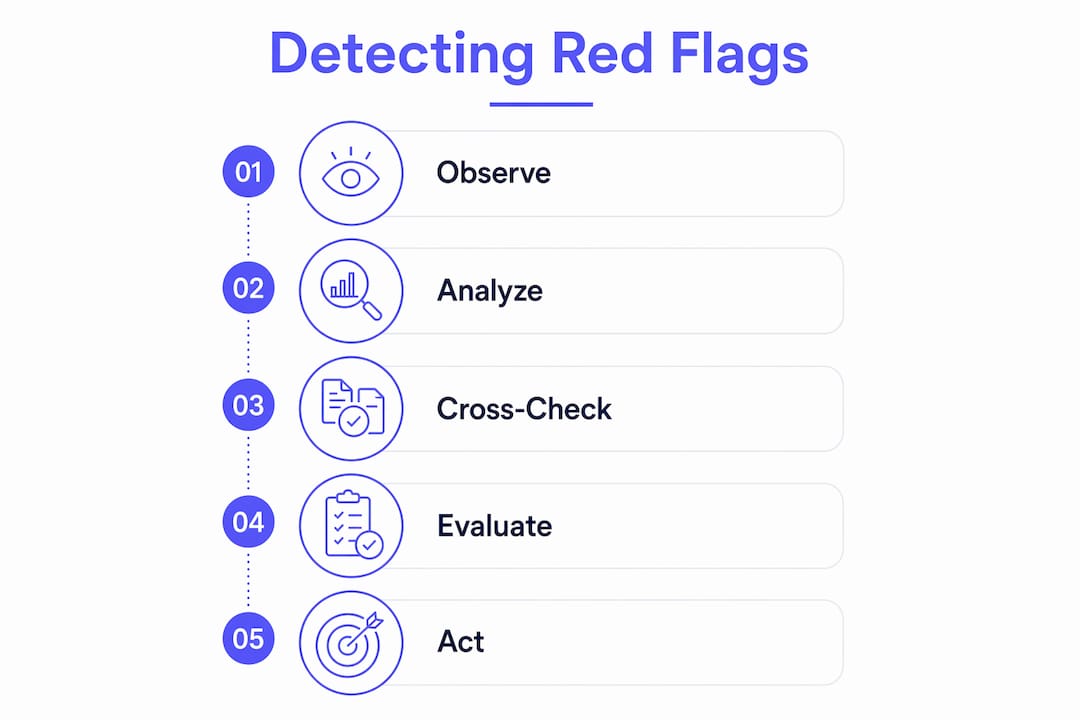
How accounting red flags shape investor decision-making
When red flags appear, they change the risk-reward calculus of a position in concrete ways. A company reporting strong earnings but generating weak operating cash flow may be pricing in growth that will not materialize once accruals reverse. An investor who spots that gap early can reduce position size, demand a higher margin of safety in valuation, or exit before the market reprices the stock.
Multiple weakening relationships in financial reporting strengthen concerns far more than any single anomaly. When revenue and profit improve but operating cash flow lags, and receivables are building while DSO rises, the combination challenges the earnings story in a way that each metric alone does not. That combination typically triggers a deeper review of revenue recognition policies, customer concentration, and payment terms before any capital decision is made.
Red flags also affect how you size positions and set monitoring thresholds. A company with clean financials and consistent cash conversion warrants different treatment than one where you have flagged two or three concerns but not yet found a definitive explanation. Adjusting position size to reflect that uncertainty is a disciplined response, not an overreaction.
Methods investors use to detect and analyze accounting red flags
Forensic investing applies investigative techniques to public filings to uncover hidden risks. The most reliable approach layers quantitative screens with careful qualitative reading of footnotes and management disclosures.

On the quantitative side, compute the CFO-to-net-income ratio for at least five years. Calculate the accrual ratio, defined as net income minus CFO divided by average total assets. A positive, growing accrual ratio implies earnings rely increasingly on non-cash accruals. The Beneish M-Score uses eight financial ratios, including the days sales in receivables index and gross margin index, to estimate the likelihood of earnings manipulation. An M-Score above -1.78 suggests potential manipulation and warrants a deeper manual review. The Altman Z-Score estimates bankruptcy risk using working capital, retained earnings, EBIT, market value of equity, and sales, with scores below 1.8 indicating high financial distress.
On the qualitative side, the footnotes are the most informative and least-read part of any filing. You should read the revenue recognition policy, related-party transaction disclosures, lease and pension commitments, and debt covenant language every time, not just when you already suspect a problem. Filingsiq’s SEC filing analysis tools extract and flag these sections automatically, cutting the time required to surface material disclosures.
Pro Tip: When reviewing a 10-K, cross-check the revenue recognition note against the receivables trend and operating cash flow in the same period. Inconsistencies across those three data points are among the most reliable early indicators of earnings quality risk.
Comparing a company’s capitalization policies and margin trends against industry peers adds another layer. If a company capitalizes costs that peers expense, the margin advantage is accounting-driven, not operational. That distinction matters when you are building a valuation model.
What happens when investors ignore accounting red flags
Ignoring investor accounting warning signs has a predictable pattern. A company reports strong earnings for several quarters. Analysts focus on the headline numbers. The stock trades at a premium multiple. Then a restatement, a regulatory inquiry, or a sudden guidance cut forces the market to reprice the stock, often violently. Investors who held through the warning signs absorb the full loss.
The common investing mistakes that follow from skipping financial statement review tend to cluster around the same failure: accepting management’s narrative without testing it against the numbers. A company can report attractive earnings for years while cash generation quietly deteriorates. By the time the divergence becomes obvious to the broader market, the damage to portfolio value is already done.
Beyond direct capital loss, ignoring red flags also creates opportunity cost. Capital tied up in a deteriorating position is capital not deployed in better-analyzed opportunities. For professional investors managing client assets, that cost compounds over time and affects long-term performance records.
Major accounting scandals and the red flags that preceded them
History provides the clearest evidence of why these warning signs matter. Enron’s collapse in 2001 was preceded by years of off-balance-sheet obligations through special-purpose entities, aggressive revenue recognition, and related-party transactions that obscured the company’s true financial position. Analysts who read the footnotes carefully found the warning signs years before the bankruptcy filing.
Tyco International, which acquired over 700 companies from 1996 to 2002, consistently understated acquired assets to lower future depreciation charges and overstated assumed liabilities to avoid immediate expense recognition. The SEC found that this pattern artificially inflated future earnings. A growth-at-any-cost acquisition strategy is itself a governance red flag that warrants heightened scrutiny of reported financials.
WorldCom’s fraud centered on expense capitalization: the company reclassified billions in operating costs as capital expenditures, inflating earnings and understating expenses over multiple periods. Investors who tracked the relationship between capital expenditure growth and revenue growth, and compared WorldCom’s capitalization policies against peers, had the data to identify the anomaly before the restatement.
The lesson across all three cases is consistent. The red flags were present in the public filings. They required cross-statement analysis and footnote reading to surface, but they were there. Early detection would have allowed investors to exit or avoid these positions before the losses materialized.
How regulators and auditing standards work to prevent accounting red flags
The SEC requires public companies to file 10-Ks, 10-Qs, and 8-Ks under strict disclosure standards, creating the paper trail that forensic analysis depends on. The Public Company Accounting Oversight Board (PCAOB) sets auditing standards for registered public accounting firms and conducts inspections to assess audit quality. When auditors identify going-concern risks or material weaknesses in internal controls, those disclosures appear in the filing and serve as formal red flags for investors.
The Sarbanes-Oxley Act of 2002, passed in direct response to the Enron and WorldCom scandals, requires CEOs and CFOs to personally certify the accuracy of financial statements and establishes criminal penalties for knowingly false certifications. Section 404 requires management and auditors to assess and report on the effectiveness of internal controls over financial reporting. A material weakness disclosed under Section 404 is one of the clearest regulatory red flags available to investors.
International Financial Reporting Standards, specifically IAS 1 for financial statement presentation, IAS 18 for revenue recognition, and IAS 240 for fraud risk in auditing, provide the framework that auditors use to identify and report anomalies. Investors reviewing filings from non-US companies should understand which standard applies and how it affects comparability with US GAAP-reported peers.
Regulatory bodies catch some problems, but they act after the fact. The SEC’s enforcement actions and PCAOB inspection reports are valuable inputs, but they lag the market. Investors who build their own red flag review process do not wait for a regulator to confirm what the financial statements already suggest.
Key Takeaways
Accounting red flags are the most reliable early warning system available to investors in public markets, and ignoring them consistently produces worse outcomes than any single bad investment decision.
| Point | Details |
|---|---|
| Red flags require cross-statement review | One anomaly rarely proves anything; multiple weakening relationships across income, balance sheet, and cash flow statements strengthen the concern. |
| CFO/net income ratio is a core check | A ratio consistently below 0.5 or negative while net income is positive signals aggressive accrual accounting and earnings quality risk. |
| Governance signals precede financial crises | CEO duality and weak audit committee independence increase earnings manipulation risk and appear in filings before headline problems emerge. |
| Footnotes contain the most material detail | Revenue recognition policies, related-party transactions, and off-balance-sheet obligations are disclosed in notes, not headline numbers. |
| Early detection protects long-term capital | Investors who identified red flags in Enron, Tyco, and WorldCom filings had the data to exit before the market repriced those stocks. |
The real cost of skipping financial statement discipline
Most investors know they should read the financials carefully. Few do it consistently, and even fewer apply a structured red flag framework across every position they hold. That gap between intention and practice is where most preventable losses originate.
What strikes me most about the major accounting scandals is not that the fraud was sophisticated. It was that the warning signs were in the public record, available to anyone willing to read past the earnings release. Enron’s special-purpose entity disclosures, WorldCom’s capital expenditure growth relative to revenue, Tyco’s acquisition accounting policies: all of it was there. The investors who avoided those losses were not smarter. They were more disciplined about cross-checking the numbers.
The practical implication for your process is this: build a checklist that covers CFO versus net income, receivables growth relative to revenue, inventory trends, capitalization policies, auditor continuity, and related-party disclosures. Apply it to every new position and every annual filing review. Tools like Filingsiq can surface these signals from 10-Ks and 10-Qs automatically, which means you spend your analytical time on judgment rather than extraction. The annual report analysis process does not need to be slow to be thorough.
Skepticism applied consistently, not just when you already suspect a problem, is what separates investors who avoid wealth destruction from those who absorb it.
How Filingsiq helps you catch red flags faster

Filingsiq’s AI platform reads 10-Ks, 10-Qs, and other SEC filings in minutes, extracting key financials, risk factor changes, and MD&A language shifts that signal accounting anomalies. Instead of spending hours parsing footnotes manually, you get a structured summary of the signals that matter most for your investment decision. Analyze your first filing and see what the headline numbers are not telling you.
FAQ
What are accounting red flags for investors?
Accounting red flags are observable warning signs in a company’s financial statements, such as receivables growing faster than revenue, persistent gaps between net income and operating cash flow, or sudden changes in accounting policies, that indicate the reported numbers may not reflect the underlying business reality.
Why does accounting quality matter to investors?
Reported earnings are easy to manage through accruals and accounting choices, but cash flow and balance sheet relationships are harder to sustain artificially over time. Investors who track earnings quality signals can identify deteriorating financial health before the broader market reprices the stock.
What is the most reliable red flag in financial statements?
A CFO-to-net-income ratio consistently below 0.5 across multiple years, while net income remains positive, is one of the strongest quantitative signals of aggressive accrual accounting and earnings quality risk.
Do accounting red flags always mean fraud?
No. A single red flag can have a legitimate explanation tied to seasonality, acquisitions, or billing cycles. The concern becomes materially stronger when multiple independent signals appear across different statements and persist without a clear management explanation.
How can investors detect red flags efficiently?
Quantitative tools like the Beneish M-Score and accrual ratio analysis help prioritize which companies warrant deeper review. Pairing those screens with careful footnote reading, specifically revenue recognition policies and related-party disclosures, gives you both the quantitative signal and the qualitative context needed to make a judgment.
Recommended
-
5 SEC Filing Red Flags Every RIA Should Watch For | FilingsIQ.ai
-
How To Spot Red Flags In SEC Filings: A Practical Guide For RIAs And Analysts | FilingsIQ.ai
-
How to Analyze a 10-K Filing: A Practical Guide for RIAs and Investment Analysts | FilingsIQ.ai
-
How Annual Report Analysis Works for Investors | FilingsIQ.ai
Related insights
Ready to analyze filings faster?
Try FilingsIQ free and turn SEC filings into actionable research in minutes.