Why Related Party Transaction Disclosure Matters
Why Related Party Transaction Disclosure Matters

Related party transaction disclosure is the practice of publicly revealing transactions between a company and entities with which it has a pre-existing relationship, such as executives, board members, or affiliated companies. Understanding why related party transaction disclosure matters is not optional for financial professionals. These transactions carry an inherent risk of non-market terms, self-dealing, and financial misstatement because they occur outside normal competitive pricing pressure. Regulatory frameworks including FASB ASC 850, SEC Regulation S-K Item 404, and IFRS IAS 24 mandate specific disclosures to protect investors and preserve market integrity. Without adequate transparency, related party deals can quietly distort a company’s financial picture in ways that standard ratio analysis will not catch.
What are the regulatory requirements governing related party disclosures?
Three major frameworks define the disclosure of related party transactions for public companies. Each sets different thresholds and requirements, but all share the same core objective: give investors enough information to assess whether a transaction serves the company or the insider.
FASB ASC 850 governs U.S. GAAP reporting. It requires companies to disclose the nature of the relationship, a description of the transaction, the dollar amounts involved, and any amounts due to or from related parties. Critically, RPTs pose higher risks of financial misstatement and conflicts of interest, with common red flags including nonstandard terms and the absence of a clear business purpose. That finding means auditors and analysts cannot simply accept management’s characterization of a deal as arm’s length.

SEC Regulation S-K Item 404 applies to public company proxy statements and registration filings. It requires disclosure of any transaction exceeding $120,000 in which a related person has a direct or indirect material interest. Inadequate disclosure can lead to enforcement actions, restatements, SEC comment letters, and shareholder lawsuits. The SEC’s threshold is a floor, not a ceiling. Companies that disclose only what the rule technically requires often face follow-up comment letters demanding more detail.
IFRS IAS 24 applies to companies reporting under international standards. It requires disclosure of related party relationships even when no transactions have occurred, which is a stricter standard than U.S. GAAP in some respects. IAS 24 focuses on the potential for influence, not just actual financial flows.
Key items required across all three frameworks include:
-
The nature of the related party relationship
-
A description of the transaction and its business purpose
-
The dollar amount or fair value of the transaction
-
Any outstanding balances, including terms and settlement conditions
-
Whether the transaction was conducted on arm’s-length terms, and the basis for that claim
Materiality is a critical concept here. A transaction does not need to be large to require disclosure. Qualitative factors, including the identity of the related party and the nature of the relationship, can make even a small transaction material.
Pro Tip: When reviewing a 10-K or proxy statement, cross-reference the related party footnote against the MD&A and the compensation tables. Discrepancies between these sections are a primary trigger for SEC comment letters.
Why do related party transaction disclosures matter for investors?
The importance of related party transactions extends well beyond accounting compliance. These disclosures are a direct window into a company’s governance quality and the integrity of its management team.
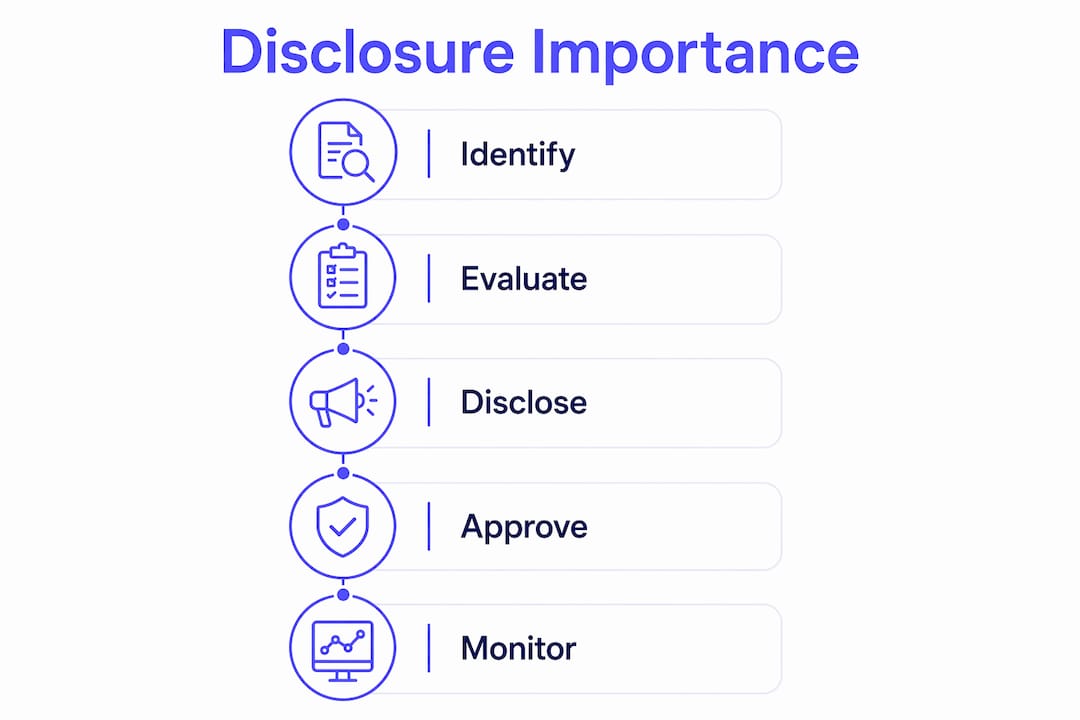
The core risk is conflict of interest. When a CEO directs company business to a firm owned by a family member, or when a board approves a lease with a property company controlled by the chairman, the transaction may benefit the insider at the expense of shareholders. Stakeholders demand insight into RPTs to assess whether long-term value is being prioritized over short-term self-dealing. That demand has grown as ESG accountability has become a standard part of institutional due diligence.
The financial risks are concrete:
-
Overpayment for goods or services supplied by a related party at above-market rates
-
Revenue inflation through sales to affiliated entities that are later reversed
-
Asset transfers at below-market prices that strip value from the public company
-
Loan arrangements with non-market interest rates that obscure the true cost of capital
Poor disclosure has real consequences. Enforcement actions, restatements, and shareholder lawsuits follow companies that fail to meet disclosure standards. Restatements are particularly damaging because they signal that prior financial statements were unreliable, which destroys investor confidence and often triggers securities litigation.
Transparency in related party transactions is now a key component of ESG accountability. Investors and governance analysts treat the quality of RPT disclosure as a direct signal of whether management prioritizes shareholder interests or its own. A company that discloses thoroughly is signaling that it has nothing to hide. A company that discloses minimally is signaling the opposite.
For analysts reviewing SEC filing red flags, related party footnotes are one of the first places to look when governance quality is in question.
How do qualitative factors and non-cash transactions affect disclosure?
Most financial professionals default to dollar thresholds when deciding what requires disclosure. That approach misses a significant portion of the real risk.
Materiality for RPTs is qualitative, not solely quantitative. Even small transactions involving related parties can be material by nature and require disclosure. A $50,000 consulting contract with the CFO’s spouse is not material by dollar amount in a billion-dollar company. It is material because of who is on the other side of the deal.
Non-cash transactions carry the same disclosure obligation as cash transactions. Regulatory focus is on relationship transparency, not just cash flow presence. Common non-cash arrangements that require footnote disclosure include:
-
Rent-free use of facilities owned by a related party
-
Free or below-market services provided by an affiliated entity
-
Loan guarantees extended by a controlling shareholder
-
Intellectual property licensed at non-market rates
-
Equipment or inventory transferred at values that differ from fair market value
Auditors operating under ISA 550 are trained to look beyond management’s documentation. ISA 550 treats related party transactions outside normal business as high-risk and demands rigorous evaluation and disclosure checks. That means testing whether the stated terms reflect actual market conditions, not simply accepting a management assertion that a deal was arm’s length.
Understanding qualitative filing disclosures is a skill that separates thorough analysts from those who only scan the numbers.
Pro Tip: When in doubt, disclose. Conservative disclosure costs nothing and protects the company from costly regulatory challenges. Regulators rarely penalize companies for disclosing too much. They frequently penalize companies for disclosing too little.
What best practices help companies manage RPT disclosures effectively?
Effective management of related party transaction disclosures requires a system, not just good intentions. The following practices define what rigorous compliance looks like in practice.
Maintain a centralized related party register. Maintaining a centralized, up-to-date related party register and coordinating disclosures across departments is critical to avoid incomplete or inaccurate disclosures. This register should be updated at least quarterly and reviewed before every filing.
Align disclosures across all filings. Consistency across financial statements, proxy filings, and registration statements is critical. Even minor inconsistencies are primary triggers for regulatory red flags. The related party footnote in the 10-K must match the disclosure in the proxy statement and any S-1 or S-3 registration filings.
Apply policies without exception. Selective application of RPT policies is a major compliance failure and a red flag for regulators. If the policy requires independent board approval for transactions above a certain threshold, that requirement applies to the CEO and the controlling shareholder equally. Regulators cite inconsistent application as evidence of bad faith.
Require independent approval and documentation. Every material related party transaction should be approved by disinterested directors or an audit committee, with written documentation of the business rationale and the basis for the pricing. Verbal approvals and informal arrangements are not defensible under SEC or FASB standards.
Engage auditors proactively. Auditors are trained to identify transactions lacking genuine business substance. Bringing auditors into the process early, rather than presenting completed transactions for sign-off, reduces the risk of late-stage disclosure problems.
Use technology to track and flag transactions. AI-powered tools that monitor financial data and flag related party activity can catch transactions that manual review misses. For analysts reviewing filings, platforms that surface and summarize related party footnotes across multiple filings save significant time and reduce the risk of oversight.
Pro Tip: Build your related party register into your financial close process, not your filing preparation process. Transactions identified after the close are harder to document and more likely to be disclosed inconsistently.
For a broader view of how to apply these practices to SEC filings, the SEC filing analysis best practices guide covers the full disclosure review workflow.
Key Takeaways
Thorough related party transaction disclosure is the single most reliable signal of governance quality available in a public company’s financial filings.
| Point | Details |
|---|---|
| Regulatory frameworks are specific | FASB ASC 850, SEC Item 404, and IFRS IAS 24 each mandate disclosure of relationship nature, terms, and transaction amounts. |
| Qualitative materiality controls | Small transactions can require disclosure based on relationship type, not just dollar size. |
| Non-cash transactions are not exempt | Rent-free use, free services, and loan guarantees all require footnote disclosure under FASB ASC 850. |
| Consistency across filings is non-negotiable | Discrepancies between the 10-K, proxy, and registration filings are a primary trigger for SEC comment letters. |
| Selective enforcement is a red flag | Applying RPT policies inconsistently signals bad faith to regulators and invites enforcement action. |
The real cost of treating RPT disclosure as a checkbox
After years of reviewing SEC filings, the pattern I see most often is not outright fraud. It is complacency. Companies disclose the minimum required, use boilerplate language, and assume that technical compliance is sufficient. It is not.
The quality of related party disclosure tells you something that the income statement cannot. A company that describes its related party transactions with specificity, explains the business rationale, and confirms independent approval is showing you its governance culture. A company that buries a vague two-sentence footnote is showing you something else entirely.
Investor scrutiny around governance and ESG accountability has intensified. Institutional investors and proxy advisory firms now score companies on the quality of their RPT disclosures, not just their existence. A disclosure that meets the technical standard but obscures the economic reality of a transaction will attract attention from governance analysts even if it satisfies the auditor.
The companies that handle this well treat disclosure as a communication exercise, not a compliance exercise. They ask: “Does this footnote give an informed investor everything they need to assess this transaction?” That question produces better disclosures than any checklist.
— Matthew
How Filingsiq helps analysts review related party disclosures
Financial professionals who review SEC filings regularly know how time-consuming it is to locate, compare, and evaluate related party footnotes across multiple filings and fiscal years.

Filingsiq’s AI-powered platform reads 10-Ks, 10-Qs, and proxy statements and surfaces key disclosures including related party transactions in minutes. The platform flags changes in disclosure language between periods, a critical signal when governance quality is in question. For RIAs, equity researchers, and compliance professionals who need to assess related party transaction risks across a portfolio of companies, Filingsiq reduces research time and eliminates the risk of missing a buried footnote. You can review the full feature set and pricing plans to find the tier that fits your workflow.
FAQ
What is a related party transaction?
A related party transaction is any business deal between a company and an entity with which it has a pre-existing relationship, such as an executive, board member, major shareholder, or affiliated company. These transactions require disclosure because they may not reflect arm’s-length market terms.
What does FASB ASC 850 require companies to disclose?
FASB ASC 850 requires disclosure of the nature of the related party relationship, a description of the transaction, the dollar amounts involved, and any outstanding balances. It also covers non-cash transactions such as rent-free use of facilities or free services.
Why do non-cash related party transactions require disclosure?
Regulatory focus is on the relationship and its potential influence, not just whether money changed hands. A rent-free facility or a below-market loan guarantee can transfer value just as effectively as a cash payment, so both require footnote disclosure.
How does the SEC enforce related party disclosure requirements?
The SEC enforces disclosure through comment letters, enforcement actions, and restatement demands. Inadequate or inconsistent related party disclosures are a documented trigger for SEC review, and companies that fail to correct deficiencies face the risk of shareholder litigation.
How can analysts identify weak related party disclosures in SEC filings?
Analysts should cross-reference the related party footnote in the 10-K against the proxy statement and any registration filings. Vague language, missing transaction amounts, and inconsistencies between filings are the clearest signals that a disclosure warrants deeper scrutiny.
Recommended
-
5 SEC Filing Red Flags Every RIA Should Watch For | FilingsIQ.ai
-
The MD&A Section Explained: What RIAs Need to Know (And What to Look For) | FilingsIQ.ai
-
How To Spot Red Flags In SEC Filings: A Practical Guide For RIAs And Analysts | FilingsIQ.ai
-
The Role of MD&A in Filings: An Analyst’s Guide | FilingsIQ.ai
Related insights
Ready to analyze filings faster?
Try FilingsIQ free and turn SEC filings into actionable research in minutes.