Role of General Counsel in SEC Filings: 2026 Guide
Role of General Counsel in SEC Filings: 2026 Guide

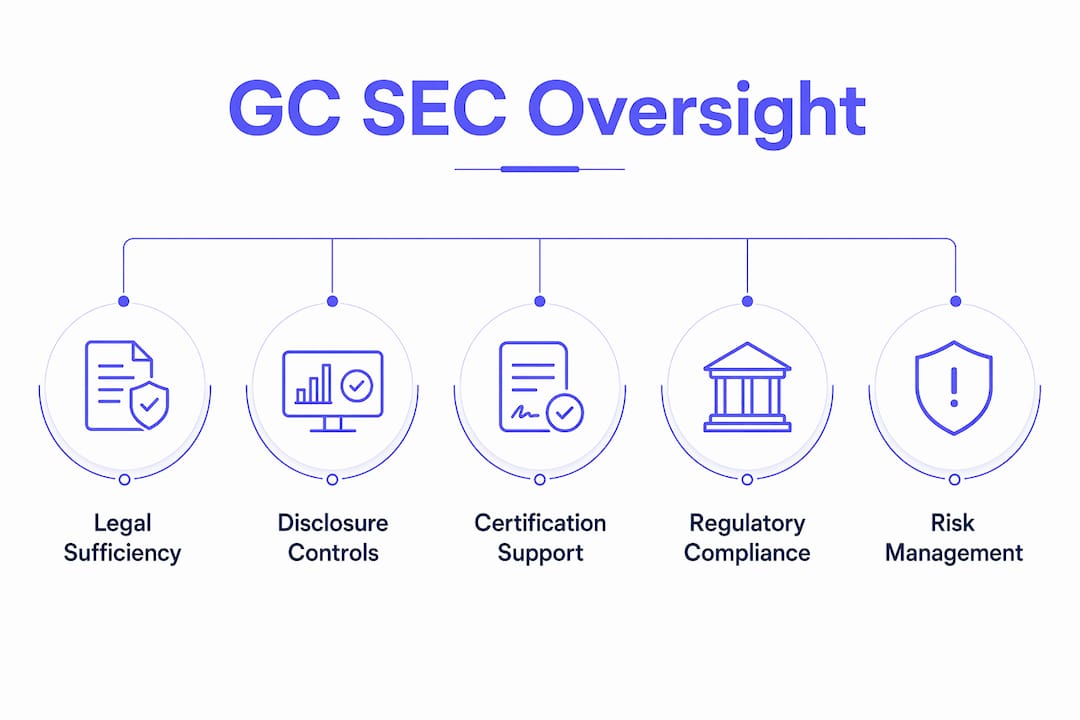
The general counsel’s primary function in SEC filings is to ensure the legal sufficiency and regulatory accuracy of every disclosure document a public company submits to the Securities and Exchange Commission. This role, formally recognized as part of corporate counsel SEC filings oversight, sits at the intersection of legal review, governance, and enterprise risk management. The general counsel does not sign periodic reports. Instead, the GC builds the legal infrastructure that makes accurate CEO and CFO certifications possible. Understanding this distinction is the first step toward running a defensible disclosure process.
How does the role of general counsel in SEC filings interact with certifications?
The CEO and CFO carry statutory certification obligations under Exchange Act Rules 13a-15 and 15d-15, attesting that disclosure controls are effective and that financial statements fairly present the company’s condition. The general counsel does not sign these certifications. The GC’s job is to make those certifications defensible by ensuring all material legal information reaches the certifying officers before they sign.
This distinction between legal sufficiency and financial accuracy defines the GC’s scope. Financial accuracy belongs to the CFO and the audit team. Legal sufficiency covers legal proceedings, contractual obligations, contingent liabilities, regulatory investigations, and any other legally material facts that must appear in the filing. If the GC misses a pending material litigation, the CEO and CFO certify a deficient document without knowing it.
Disclosure controls and procedures, as defined under Exchange Act Rule 13a-15, are designed to ensure information flows to certifying officers from every corner of the organization. The GC sits inside that information flow as the gatekeeper for legal inputs. This means the GC must run a structured process for collecting, reviewing, and escalating legally material information on a quarterly and annual basis.
Key responsibilities the GC owns within this certification framework include:
-
Reviewing all legal proceedings disclosures for completeness and accuracy before filing
-
Advising the CEO and CFO on any legal developments that could affect their certifications
-
Coordinating with outside counsel on pending litigation and regulatory matters
-
Confirming that internal control over financial reporting (ICFR) assessments reflect known legal risks
-
Escalating material legal changes discovered after draft completion but before filing
Pro Tip: Build a formal legal disclosure checklist tied to each Form 10-K and 10-Q cycle. Circulate it to every business unit attorney at least three weeks before the filing deadline so legal inputs arrive before the CFO’s certification review, not after.
What SEC disclosure requirements specifically depend on general counsel oversight?
Regulation S-K Item 401 requires detailed personal background disclosures for all directors and executive officers, including any legal proceedings within the past ten years that are material to an evaluation of their character or integrity. This disclosure appears in registration statements, proxy statements, and annual reports on Form 10-K. It is one of the most GC-intensive disclosure obligations in the SEC’s rulebook.
Managing Item 401 accurately requires pulling data from multiple internal sources that rarely talk to each other. HR systems hold employment history. Board records contain director appointment dates and committee assignments. Legal files hold litigation history. The GC must reconcile all three to produce a disclosure that is complete, accurate, and consistent across every filing where it appears.
The most effective approach to Item 401 compliance follows a structured sequence:
-
Build a centralized fact book for each director and officer, updated at least annually and reviewed before every proxy season
-
Establish a single authoritative source for each data element, such as HR records for employment dates and legal files for litigation history
-
Cross-reference the fact book against prior filings to catch inconsistencies before they become SEC comment letter targets
-
Obtain written confirmation from each director and officer that their disclosed background is accurate and complete
-
Document the review process so you can demonstrate due diligence if the SEC questions a disclosure
| Disclosure type | Primary data source | GC oversight priority |
|---|---|---|
| Legal proceedings (Item 401) | Legal files, outside counsel | High: direct GC review required |
| Employment history | HR systems | Medium: GC validates against legal records |
| Board committee assignments | Corporate secretary records | Medium: GC confirms accuracy |
| Pending litigation (Item 103) | Litigation tracking system | High: GC owns completeness review |
| Regulatory investigations | Compliance and legal files | High: GC escalates to certifying officers |
Pro Tip: Treat your Item 401 fact books as living documents, not annual projects. Any time a director or officer is named in new litigation or a regulatory inquiry, update the fact book immediately. Waiting until proxy season creates unnecessary risk of omission.
How do general counsel teams support SEC disclosure governance beyond document review?
The modern GC role extends well beyond reviewing draft language. GCs now function as strategic partners in enterprise risk management, translating board-level governance discussions into legally compliant disclosure language. This shift means the GC must understand not just what happened legally, but what the SEC expects investors to know about it.

Coordination with the audit committee is one of the most consequential parts of this expanded role. The audit committee oversees financial reporting integrity and engages directly with external auditors. The GC provides the legal risk context that auditors and committee members need to assess whether financial statement disclosures are complete. A GC who attends audit committee meetings only when invited misses the opportunity to surface legal risks before they become disclosure problems.
Technology and data governance have become integral to disclosure controls in 2026, with GC teams overseeing validation and provenance of legal information used in filings. This matters because the SEC has increased its scrutiny of disclosure accuracy, and legal teams that rely on manual processes face greater exposure to omissions and inconsistencies.
The SEC’s own leadership has emphasized materiality-driven disclosure, encouraging GCs and executives to focus on clear, necessary disclosures rather than exhaustive filings that bury material information in volume. This policy direction gives GCs a framework for pushing back against over-disclosure tendencies that add cost without adding investor value.
Governance functions the GC leads or co-leads in the disclosure cycle include:
-
Chairing or participating in the disclosure committee, which reviews draft filings before submission
-
Maintaining a legal risk register that feeds directly into the MD&A and risk factors sections
-
Overseeing the SEC filing analysis process to identify gaps between current disclosures and evolving legal risks
-
Coordinating with the compliance function to capture regulatory developments that require disclosure
-
Reviewing comment letter responses to confirm legal accuracy before submission to the SEC
What practical challenges do general counsel face in managing SEC filing responsibilities?
The most persistent challenge in corporate counsel SEC filings work is data fragmentation. Legal information relevant to disclosures lives in litigation management systems, outside counsel billing platforms, HR databases, board portals, and email threads. No single system aggregates it automatically. The GC must build a process that pulls from all of these sources on a defined schedule, or material information will fall through the gaps.
Cross-functional collaboration with the finance team is the second major friction point. Finance teams operate on tight reporting deadlines and often view legal review as a bottleneck. GCs who integrate into the financial reporting calendar early, rather than receiving draft filings for comment at the last minute, consistently produce more accurate disclosures. The quarterly 10-Q filing cycle leaves little room for late-stage legal revisions, which makes early involvement non-negotiable.
AI and legal technology are transforming how GC teams manage SEC filing workflows in 2026, improving compliance accuracy and reducing the manual burden of disclosure review. Tools that track changes in risk factor language across filing periods, flag new litigation references, or compare current disclosures against prior filings give legal teams a structural advantage in catching omissions before they reach the SEC.
Balancing legal sufficiency against business strategy is a subtler challenge that experienced GCs navigate constantly. Business units sometimes resist disclosing pending regulatory inquiries or litigation risks because they fear market reaction. The GC’s job is to hold the line on disclosure obligations while working with business leaders to frame disclosures accurately and without unnecessary alarm. This requires both legal authority and organizational credibility.
Pro Tip: When a business unit pushes back on a disclosure, document the legal basis for including it and escalate to the CEO and CFO directly. Certifying officers need to make informed decisions about disclosure calls, and the GC’s written analysis protects all parties if the SEC later questions the filing.
Key takeaways
The general counsel’s role in SEC filings is to own legal sufficiency across all disclosures, enabling accurate CEO and CFO certifications through structured information governance and cross-functional coordination.
| Point | Details |
|---|---|
| GC owns legal sufficiency | GC ensures legal proceedings, contingencies, and regulatory risks are fully captured before certifying officers sign. |
| Certifications belong to CEO/CFO | Under Rules 13a-15 and 15d-15, the CEO and CFO certify disclosure controls. The GC supports, not signs. |
| Item 401 demands structured process | Fact books and centralized sourcing prevent omissions in director and officer background disclosures. |
| Governance role extends beyond review | GC leads disclosure committees, maintains legal risk registers, and coordinates with audit committees each cycle. |
| Technology reduces disclosure risk | AI-driven tools and data governance processes help GC teams validate disclosures and catch inconsistencies at scale. |
Why the GC’s disclosure role is more strategic than most executives realize
Having worked closely with legal teams navigating SEC reporting cycles, I’ve seen a consistent pattern: companies that treat the GC as a document reviewer at the end of the process produce weaker disclosures than companies that embed the GC in the reporting calendar from day one. The difference is not legal expertise. Both types of GCs know the rules. The difference is process architecture.
The GCs who consistently produce defensible filings build systems, not just reviews. They run disclosure committees with standing agendas. They maintain legal risk registers that update in real time, not just at quarter-end. They attend audit committee meetings as a matter of course, not by invitation. And they push back on materiality calls with documented analysis rather than informal opinions.
The evolving GC role as a strategic partner in governance and enterprise risk is not a trend. It is the current expectation from boards, regulators, and institutional investors who read proxy statements carefully. GCs who position themselves as reactive legal reviewers will find their influence shrinking as disclosure complexity grows. The ones who build integrated disclosure governance functions will be indispensable.
Legal technology is accelerating this shift. GC teams that adopt AI-assisted review tools, structured data governance, and automated change-tracking are not just working faster. They are producing disclosures with fewer omissions and more consistent language across filing periods. That consistency matters to the SEC, and it matters to investors who use natural language processing tools to compare filings across quarters.
— Matthew
How Filingsiq supports legal teams in SEC filing review
Legal teams managing SEC disclosure cycles face the same problem every quarter: too much document volume, too little time to catch every material change. Filingsiq addresses this directly with an AI-driven platform that summarizes 10-Ks, 10-Qs, and other SEC filings in minutes, extracting key risk factors, legal proceedings, and management disclosures into structured summaries.

For general counsel and corporate legal teams, Filingsiq reduces the manual burden of reviewing prior filings for comparison, tracking changes in risk factor language, and identifying red flags like new litigation references or shifts in going-concern language. The platform’s AI-powered filing analysis gives legal teams a faster, more reliable foundation for disclosure review, so your team spends less time reading and more time making defensible disclosure decisions. Explore how Filingsiq can fit into your SEC reporting workflow at filingsiq.ai.
FAQ
What is the general counsel’s role in SEC filings?
The general counsel ensures the legal sufficiency of all SEC disclosures, covering legal proceedings, contingent liabilities, and regulatory risks, while supporting the CEO and CFO in meeting their certification obligations under Exchange Act Rules 13a-15 and 15d-15.
Does the general counsel sign SEC periodic reports?
No. The CEO and CFO are the certifying officers who sign periodic reports such as Form 10-K and Form 10-Q. The GC provides the legal review and governance infrastructure that makes those certifications accurate and defensible.
What is Regulation S-K Item 401 and why does it involve the GC?
Item 401 requires disclosure of directors’ and executive officers’ backgrounds, including relevant legal proceedings. The GC oversees this disclosure because it draws on legal files, HR records, and board documents that require legal judgment to reconcile and verify.
How does the GC support disclosure controls and procedures?
The GC ensures that material legal information, including litigation updates, regulatory inquiries, and contractual obligations, flows through the company’s disclosure controls to reach certifying officers before each filing deadline.
How is AI changing the GC’s SEC filing responsibilities?
AI and legal technology tools now help GC teams validate disclosure accuracy, track changes in risk factor language across filing periods, and flag new legal references in draft filings, reducing manual workload and improving consistency across quarterly and annual reports.
Recommended
Related insights
Ready to analyze filings faster?
Try FilingsIQ free and turn SEC filings into actionable research in minutes.